Governance you can watch happen.
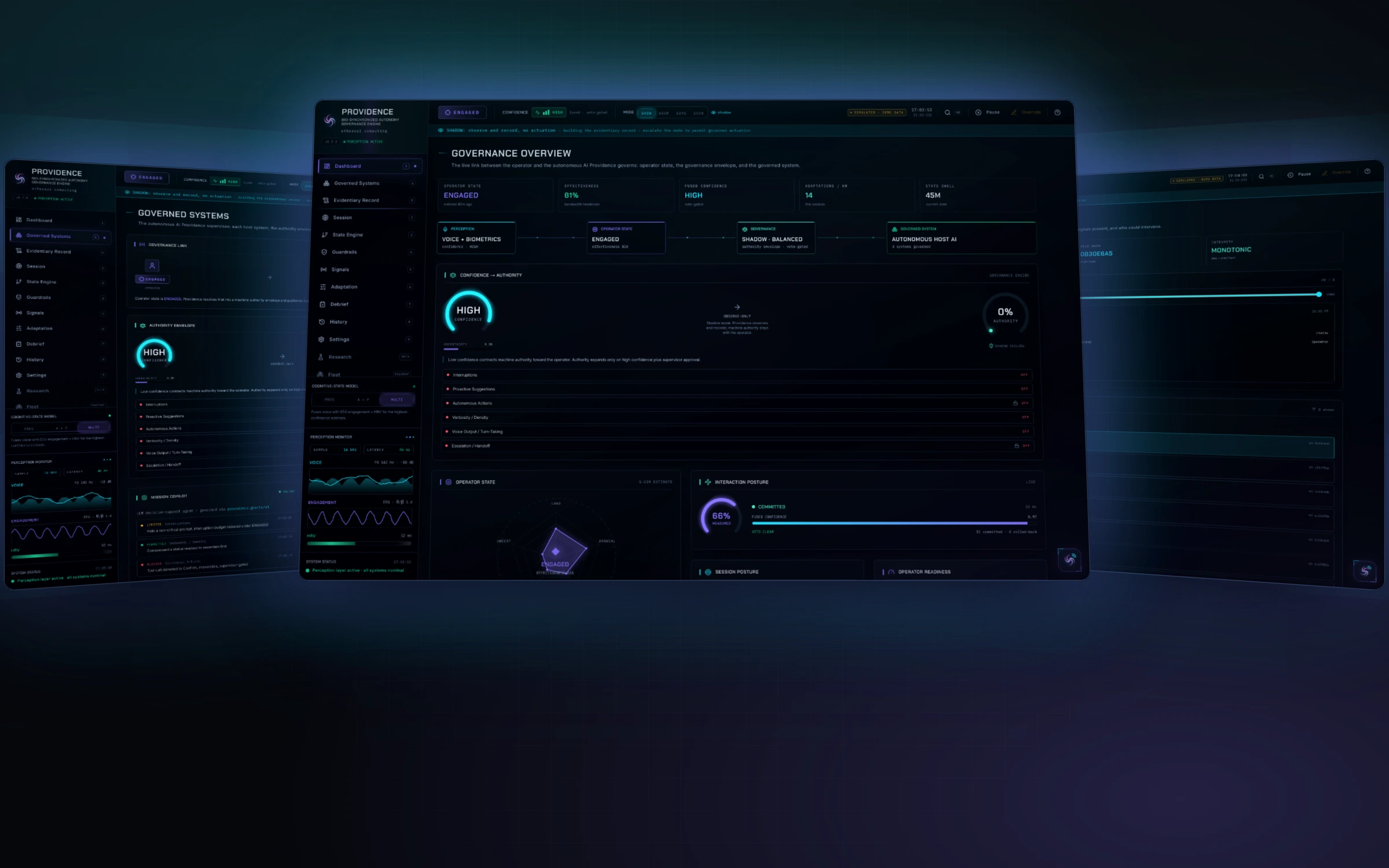
Autonomy is scaling faster than the governance around it.
As AI systems gain agency, the human role collapses from operator to supervisor. Supervisory capacity is not constant. It degrades under fatigue, overload, and time pressure, exactly where failure is least acceptable. Three gaps follow, currently unowned at the fusion point.
ACCOUNTABILITY
No one can prove, to a safety board or a court, why an autonomous system did what it did, what authority it held, or who was positioned to intervene.
AUTHORITY
Machine authority is fixed in advance. It does not account for whether the human in the loop is in any condition to exercise oversight.
AUDITABILITY
Emerging mandates are making an evidentiary record of human-AI decisions a legal precondition for deployment, not a nice-to-have.
Autonomy has a model of the world. It has no model of the human.
The conventional stack reasons about the environment and acts on it. Nothing in that path asks whether the person accountable for the outcome is in any condition to intervene. Providence occupies the layer between operator state and machine authority, and it is the layer that is currently missing.
- SENSORS01
Environment observed
- MODEL02
Inference over the environment
- ACTION03
Behavior in the world
Authority is fixed at design time. Human condition is not an input.
- OPERATOR STATE01
Readiness estimated continuously
- GOVERNANCE02
Policy mediates state into authority
- AUTHORITY03
The permitted action envelope
- AI BEHAVIOR04
Bounded by the envelope above it
Authority is resolved at run time, against the human actually present.
Providence system diagram. Operator state, at 92% readiness, is read by Providence, the control boundary. Providence grants an authority envelope currently at 78% with 94% confidence. 5 of 7 host AI nodes fall inside that envelope and may act; the remaining 2 defer to the operator.
Operator steady. The envelope is wide, and the machine acts inside it.
When confidence falls, authority contracts.
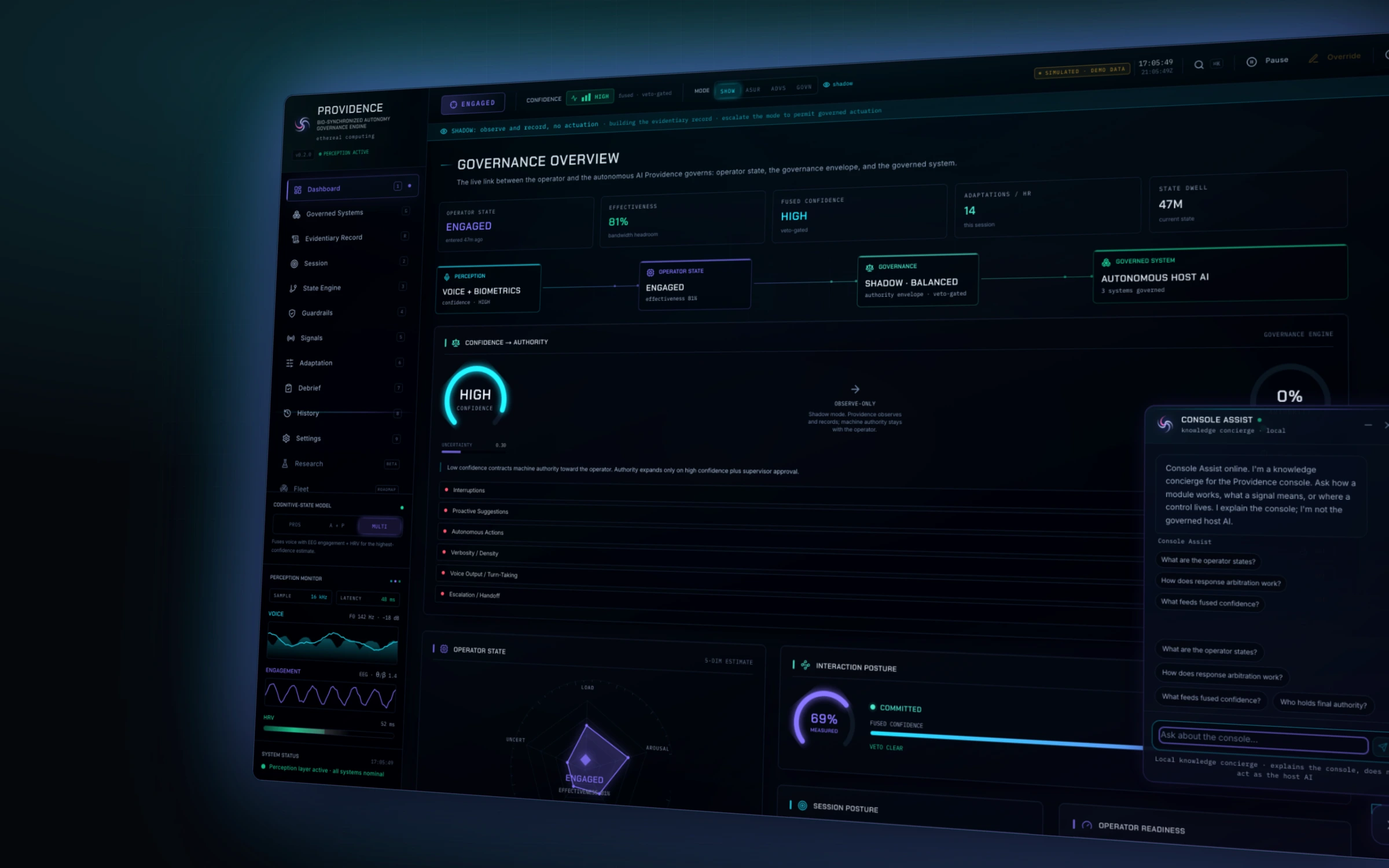
The record is becoming mandatory.
The audit and human-oversight requirement is shifting from optional to mandatory across exactly the sectors where autonomy is arriving. Operators of autonomous systems will soon be required to keep what Providence records.
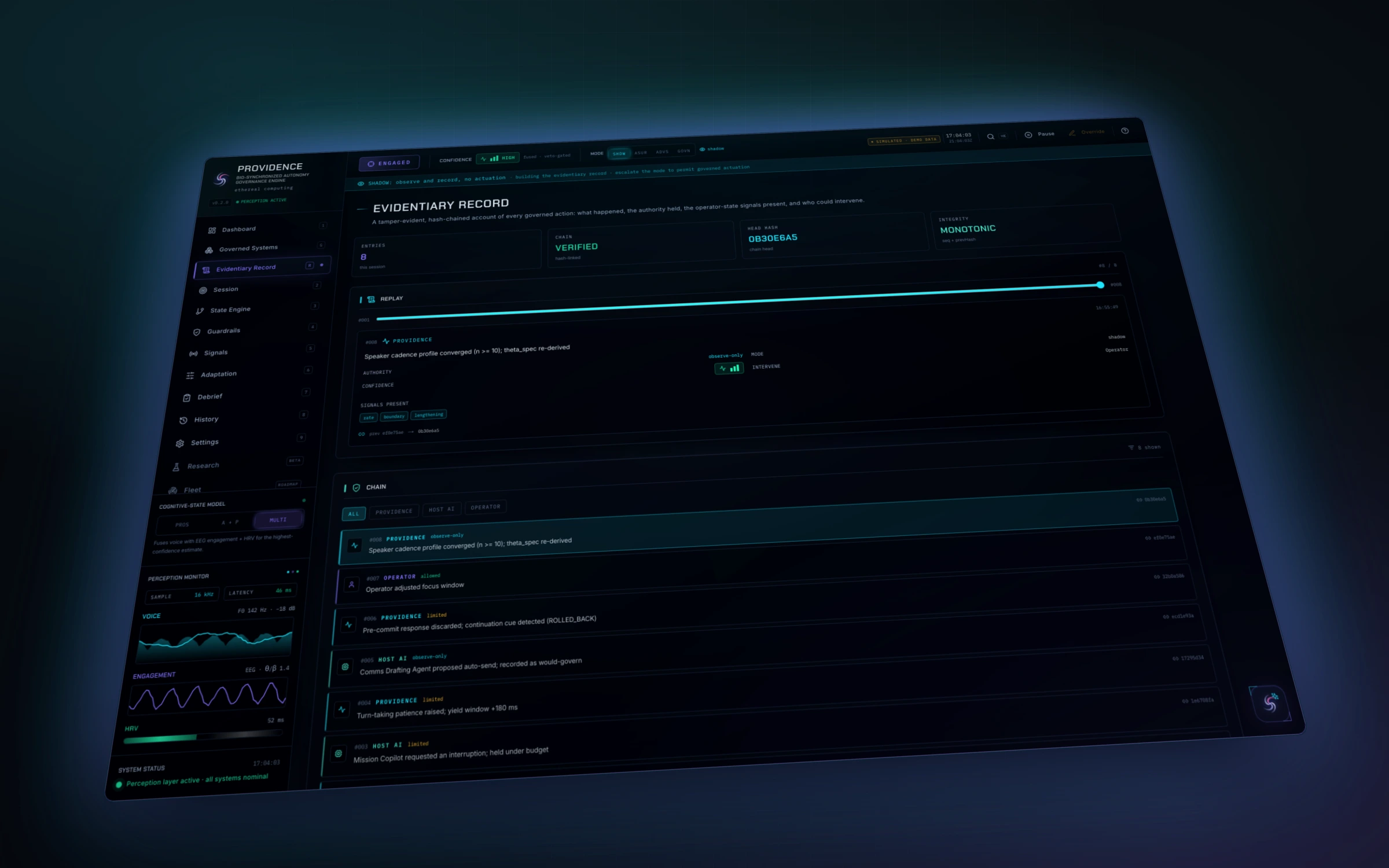
The flight recorder for human-AI teams.
Providence keeps a tamper-evident, time-synchronized record of every autonomous action: what the AI did, what authority it held, what operator-state signals were present, what confidence the system carried, and who was positioned to intervene.
When a safety board, a regulator, or a court asks why, the answer exists.
Three rules. Always in force.
POLICY MEDIATION: NEVER DIRECT ACTUATION
Operator state informs governance. Governance sets machine authority. Authority shapes behavior. Supervisors approve the policies; biosignals never directly actuate a mission outcome.
UNCERTAINTY FAILS TOWARD THE HUMAN
Every governance decision carries a confidence bound. Low confidence always contracts machine authority toward human control. Authority expands only under high confidence, supervisor pre-approval, and a log entry.
ADAPTABLE BY DEFAULT, ADAPTIVE BY OPT-IN
Operators set the working agreements; Providence enforces and logs them. The system may recommend an authority change only inside pre-approved envelopes, and never silently.
Each rung earns the next.
Providence climbs on evidence, not promises. Every stage is independently valuable, and every stage generates the proof the next one requires.
SHADOW
Observe and record. Zero actuation.
- Tamper-evident record of every autonomous action
- Authority held, signals present, who could intervene
- Autonomy forensics + mission-assurance logging
ASSURE
Policy enforcement on top of the record.
- Operators set authority levels; Providence enforces them
- Escalation routing and intervention records
- Competes on verifiability and human authority
ADVISE
Operator state, surfaced to the supervisor.
- Decision-support input, never an automatic trigger
- Customers watch the state-to-outcome correlation hold in their own data
- Trust is observed before it is asked for
GOVERN
Earned, bounded, adaptive authority.
- Supervisor-approved, uncertainty-bounded, narrow scope
- Every governance decision fails toward the human
- Reached on evidence, or not at all
Response Arbitration
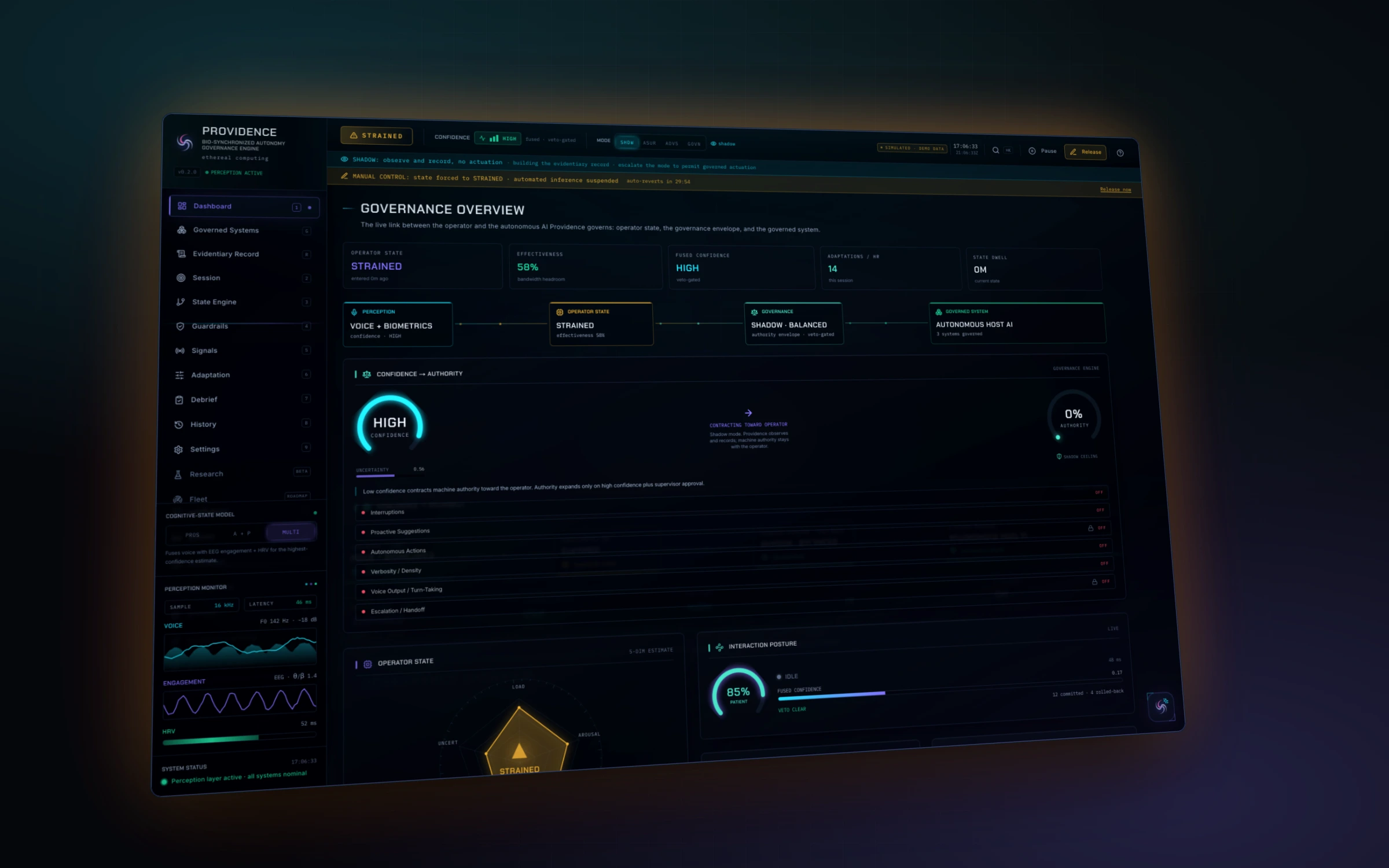
The governance loop is not slideware. A working, patent-pending arbitration engine governs when a conversational AI has earned the right to interrupt a human operator: veto-gated, cost-thresholded, and running live in the Providence console today.
The same threshold law that arbitrates a conversation is the law that will arbitrate authority.
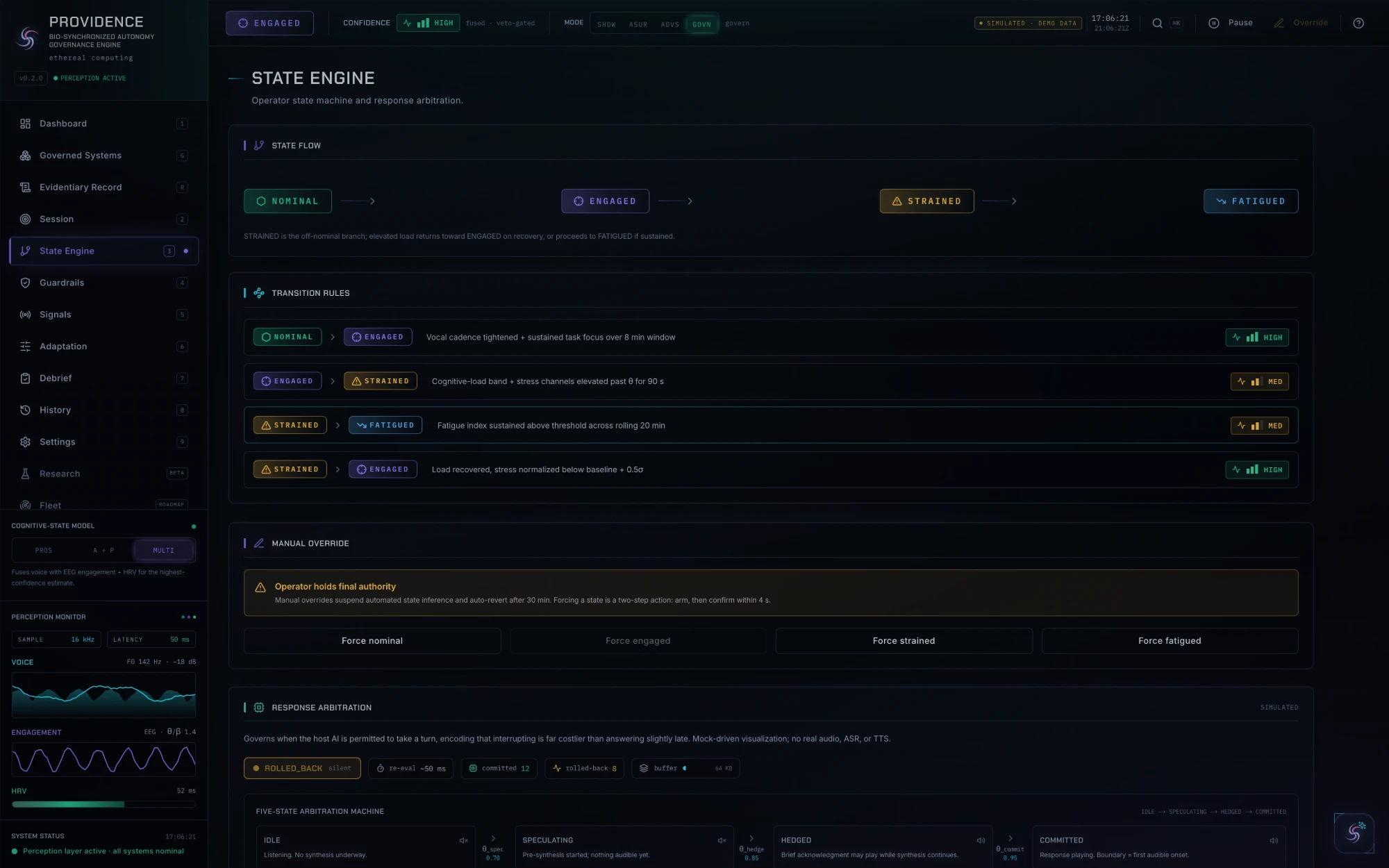
Live console · the governance loop, view by view
Built for the rooms where error has no margin.
One engine, three theaters. Providence estimates operator readiness from consented signals and governs how the autonomous systems around them are permitted to behave. Human state informs governance; governance sets machine authority; supervisors keep the last word. Readiness is a continuous estimate carrying its own uncertainty, shown here in three bands.
Human-machine teaming in mission operations
EnvironmentCommand and control, ISR exploitation, battle management, and counter-UAS cells, where one operator now supervises several semi-autonomous systems at once.
Nine hours on console, the operator misses the one alert that mattered. The autonomous host keeps acting at full authority as if nothing changed. Afterward, no one can reconstruct who held authority or who was positioned to intervene.
Providence governs the host AI's authority envelope in real time against estimated operator readiness. It never actuates a mission outcome. It sets what the AI is permitted to do, and records why.
A tamper-evident record that human judgment governed every autonomous action, with authority contracting exactly when oversight degraded.
- Full AI authority within the envelope
- Routine recommendations surfaced
- Balanced interruption tolerance
Providence is not monitoring people for monitoring's sake.
It governs how AI systems behave according to the estimated condition of the humans they support.
Supervisors retain ultimate oversight, and every step is recorded.
Keep a human in command.
We work with organizations operating autonomy where the margin for error is zero: defense test and evaluation, industrial remote operations, and mission operations.